I must be getting old b/c the only candy jewelry we had was those gross cheerio shaped things around a necklace. Oh, and ring pops. Well, this is a whole new level of culinary jewelry. You just have to see this for yourselves!
http://www.1finecookie.com/2012/04/rock-candy-jewelry-in-marshmallow-watermelon-peanut-butter-flavor-and-more-bling-bling/
Showing posts with label Diamond jewelry buyers in new york. Show all posts
Showing posts with label Diamond jewelry buyers in new york. Show all posts
Wednesday, May 16, 2012

Tuesday, February 7, 2012
Lady GaGa is Even Buying GOLD!
Well, this isn't quite a spectacular blog, but it's AMAZING, GaGa on Delancy, on the LES!!! Buying, what else?? GOLD!! Check this out!
http://www.boweryboogie.com/2012/01/lady-gaga-at-solid-gold-jewelry-on-delancey/
http://www.boweryboogie.com/2012/01/lady-gaga-at-solid-gold-jewelry-on-delancey/
Wednesday, January 25, 2012
Is it Silver or Silverplate? How can one tell?
Is my piece Silver or Silverplate? How can I tell?
I often encounter antique pieces marked with hallmarks other than the typical .925 to identify the piece as sterling. Sterling Silver flatware manufactured in America after 1849 is ALWAYS stamped with one or the following markings:

I often encounter antique pieces marked with hallmarks other than the typical .925 to identify the piece as sterling. Sterling Silver flatware manufactured in America after 1849 is ALWAYS stamped with one or the following markings:
- The word STERLING stamped on it
- 925 stamped on it
- STER stamped on it.
If, for example, your flatware is stamped "Wm & Rogers" and "IS", it is not sterling silver. The IS merely indicates "International Silver" which was the company that actually manufactured the set. Because the pieces have no stamping to indicate Sterling, they most definitely are NOT sterling. Manufacturers never neglected to mention the word Sterling on their pure silver sets, while they always "neglected" to mention the lack of purity on mere plated material.
British sterling carries 4-5 stamped hallmarks identifying the company, the location, date of manufacture, etc. These can be matched with photos in the silver hallmark database (google it). Similarly, American manufacturers employ hallmarks or sponsor's marks that can be identified by matching photos.
The first patent for silver plating was issued in 1840. Older pieces are sterling, although they may not be stamped as such.
Some of the early makers of silverplate flatware seen regularly in the store are Rogers Bros, Rogers & Bros. FB Rogers Silver, Wm Rogers, the Meriden Britannia Company, Middletown Plate Co. (Superior Silver Company) and others. Many of these names were used well into the 20th century. In 1898, this group of companies formed the International Silver Company.
Some of the silverplate manufacturers also released sterling patterns, but these are stamped "sterling," whereas the plate is not. Many of the sterling pattern numbers are recorded in a database or databases.
Some of the stamps used to distinguish silverplated tableware are: IS (International Silver), IC, Brittania, EPNS (Electical Plated Nickle Silver), A1, Triple Plate, 3x, Quadruple Plate, 4x, Silver on Copper, EP, EP on Copper, and a whole host of initial and pictorial marks that can be matched with pictures in the silverplate database.
Myth #1: Silverplate is magnetic; silver is not. In truth, neither is magnetic. Stainless steel shows varying degrees of magnetism.
Myth #2: Silverplate doesn't tarnish like genuine silver. In truth, both will tarnish, because both are genuine silver. The difference is, sterling is sterling silver all the way through; plate only has a thin skin of silver over a base metal. Stainless steel doesn't tarnish.
Unfortunately, to buyers, silverplate has no scrap value. Even the thickest plate is only about .20mm thick, and refineries won't buy it because the process of reclaiming silver from plate is too expensive.
Pictured here is a William Rogers set which has a higher retail value as an antique than for silver value.

I have also enclosed some resources to evaluate your flatware or silverware.
Tuesday, January 17, 2012
What the cut says about the diamond....
To understand antique diamonds, it's helpful to examine the modern diamond. In the simplest version, a modern diamond has 3 main parts. The top of the diamond is called the crown and the bottom is called the pavilion. The part that separates the crown and pavilion is called the girdle. A modern brilliant cut diamond has 57-58 facets or polished surfaces. The flat part on top of the diamond is the table, which is the largest facet. The culet is a tiny facet at the very bottom of the pavilion. If the pavilion comes to a point at the bottom, the diamond does not have a culet.
 Antique diamonds have a soft romantic glow that many people find very appealing. Antique diamonds typically have smaller tables, higher crowns, deeper pavilions and thicker girdles than their modern counterparts. Antique diamonds were cut to maximize carat weight, not "fire". That's why the proportions of old diamonds are quite different from their modern counterparts.
Diamonds were cut by hand until the early 1900's. This was a laborious, time-consuming process. Unfortunately, many antique diamonds have been re-cut with modern cutting techniques. This has caused demand for these old cut diamonds to soar in recent years, along with the prices that people are willing to pay for them.
Let's go over some of the older cuts, so we can get an idea of what I mean.
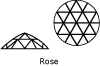
(1) Rose cut diamonds were introduced as early as the 1500's and were popular until the early 1900's. The shape of a rose cut diamond resembles the petals of a rose bud. The bottom is flat.


(3) The old European diamond has a very small table, a heavy crown, and great overall depth. This diamond cut was the fore-runner of the modern brillant cut. Like the modern round brilliant, the old European diamond has a circular girdle.
Diamonds were cut by hand until the early 1900's. This was a laborious, time-consuming process. Unfortunately, many antique diamonds have been re-cut with modern cutting techniques. This has caused demand for these old cut diamonds to soar in recent years, along with the prices that people are willing to pay for them.
Let's go over some of the older cuts, so we can get an idea of what I mean.
(1) Rose cut diamonds were introduced as early as the 1500's and were popular until the early 1900's. The shape of a rose cut diamond resembles the petals of a rose bud. The bottom is flat.
(2) The old mine cut diamond is the earliest form of the modern brilliant cut. Also called the "cushion cut", it has a cushioned shaped girdle.

(3) The old European diamond has a very small table, a heavy crown, and great overall depth. This diamond cut was the fore-runner of the modern brillant cut. Like the modern round brilliant, the old European diamond has a circular girdle.

Friday, January 13, 2012
"Watch Me Go into The Past With You."

On July 1, 1941 the Brooklyn Dodgers played the Philadelphia Phillies. This game was televised, but before it began, something was shown that had never been seen before - a televised advertisment for a consumer product. And for what was the world's first televised advertisement? A watch, of course. The ad that was first to take over all other ads was for Bulova wristwatches, one of the great American timepiece companies. The ad is pretty simple by today's standards, but that's ok - it only cost Bulova $9. Priceless. http://youtu.be/lsjc2uDi1OI
As Quentin Tarantino so brilliantly captures in this scene from ‘Pulp Fiction’, a watch is something that really begs to be looked after. Because a watch is more than just an object that tells you the time – it’s a token of love, a cherished heirloom, a piece of history.
There’s also an extreme sense of indivituality, to know no one in the room will have the same piece as you. To Be Continued...
Sunday, January 8, 2012
What happens after you sell your Gold & Silver?

There are actually a few different methods of refining gold. Depending upon the quantity of gold you are working with and the desired level of purity, the two most common methods for refining gold are the use of high temperature flame and the use of chemicals to refine the gold.
Refining with flame is one of the oldest methods of refining metals. Mentioned even in the bible, refining by fire is the preferable method for larger quantities of gold. In ancient times, this form of refining involved a craftsman sitting next to a hot fire with molten gold in a crucible being stirred and skimmed to remove the impurities or dross that rose to the top of the molten metal. With flames reaching temperatures in excess of 1000 degrees Celsius, this job was definitely a dangerous occupation for the gold refiner. The tradition remains largely untouched today with the exception of a few advancements in safety and precision.
The second method of refining gold involves the use of chemicals. Strong acids are used to dissolve the impurities in the gold ore and afterwards, are neutralized and washed away, taking the impurities with them. The resulting product is a muddy substance that is almost pure gold (99.999% or 24K). This muddy substance is dried until it is a powdered residue and then heated with a torch or other source of heat to melt the gold powder into useable gold. The acids used for this process are Nitric acid and Hydrochloric acid.

A silver refiner provides precious metal recovery that recycles material, keeping it out of landfills. Whether it be scrap metal or jewelry, the process of refining silver separates silver from other metals and waste. Scrap from the process, such as silver metal foil, silver leaf, and antique silver is weighed and smelted. As the scrap becomes liquified in a furnace, ash and borax are included to separate pure silver from other precious and non-precious metals.
The largest consumers of silver are Kodak and Fuji. That is because more silver is used for photography than any other product. Large amounts of silver are also used for silverware, jewelry and industrial products. Silver is also used to treat burn victims as it kills bacteria, allowing the individual to heal more quickly. Silver has the highest electrical and thermal conductivity of any metal.
Now back to the refining process. The Silver refiner mixes silver in with other metal, such as gold and copper, because different amounts of other precious metals can be in a piece of jewelry. The refiner of silver creates bars of metal and dumps them into ice water to reduce particle size. The bars are dissolved in nitric acid and hydrochloric acid for six to twelve hours. Nitric acid attacks the silver and copper and puts the metals in liquid form. The pure silver is then extracted, dried and cooled.

The refining of silver puts the precious metal back into use, making a positive impact on the world around us. Worn-down jewelry, scrap silver, and silver coins can be refined into pure silver bullion. As the price of silver continues to increase, selling that bullion can be a windfall for an individual, and thus silver refining is becoming a growing business. Refining sterling silver produces silver and other metals as sterling silver is more than 92 percent silver, with the remaining eight percent being copper or another metal. The added metal provides strength as items of 100 percent silver would bend. Sterling silver is primarily used for jewelry and silverware.
Silver refiners have the expertise to melt silver jewelry and other pieces of jewelry into their liquid form and rework them into other uses. Most also buy, refine gold, silver and platinum. I hope we both learned as much from this lesson as I.
Tuesday, November 1, 2011
Selling Diamonds and Diamond Jewelry in Long Island
 |
| Diamond Solitaire Stud Earrings |
Subscribe to:
Posts (Atom)