Showing posts with label Jewelry Buyers. Show all posts
Showing posts with label Jewelry Buyers. Show all posts
Tuesday, June 5, 2012

Tuesday, January 17, 2012
What the cut says about the diamond....
To understand antique diamonds, it's helpful to examine the modern diamond. In the simplest version, a modern diamond has 3 main parts. The top of the diamond is called the crown and the bottom is called the pavilion. The part that separates the crown and pavilion is called the girdle. A modern brilliant cut diamond has 57-58 facets or polished surfaces. The flat part on top of the diamond is the table, which is the largest facet. The culet is a tiny facet at the very bottom of the pavilion. If the pavilion comes to a point at the bottom, the diamond does not have a culet.
 Antique diamonds have a soft romantic glow that many people find very appealing. Antique diamonds typically have smaller tables, higher crowns, deeper pavilions and thicker girdles than their modern counterparts. Antique diamonds were cut to maximize carat weight, not "fire". That's why the proportions of old diamonds are quite different from their modern counterparts.
Diamonds were cut by hand until the early 1900's. This was a laborious, time-consuming process. Unfortunately, many antique diamonds have been re-cut with modern cutting techniques. This has caused demand for these old cut diamonds to soar in recent years, along with the prices that people are willing to pay for them.
Let's go over some of the older cuts, so we can get an idea of what I mean.
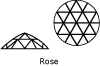
(1) Rose cut diamonds were introduced as early as the 1500's and were popular until the early 1900's. The shape of a rose cut diamond resembles the petals of a rose bud. The bottom is flat.


(3) The old European diamond has a very small table, a heavy crown, and great overall depth. This diamond cut was the fore-runner of the modern brillant cut. Like the modern round brilliant, the old European diamond has a circular girdle.
Diamonds were cut by hand until the early 1900's. This was a laborious, time-consuming process. Unfortunately, many antique diamonds have been re-cut with modern cutting techniques. This has caused demand for these old cut diamonds to soar in recent years, along with the prices that people are willing to pay for them.
Let's go over some of the older cuts, so we can get an idea of what I mean.
(1) Rose cut diamonds were introduced as early as the 1500's and were popular until the early 1900's. The shape of a rose cut diamond resembles the petals of a rose bud. The bottom is flat.
(2) The old mine cut diamond is the earliest form of the modern brilliant cut. Also called the "cushion cut", it has a cushioned shaped girdle.

(3) The old European diamond has a very small table, a heavy crown, and great overall depth. This diamond cut was the fore-runner of the modern brillant cut. Like the modern round brilliant, the old European diamond has a circular girdle.

Wednesday, November 2, 2011
Fine Diamond Jewelry & Estate Jewelry
 |
| Art Deco Ruby & Diamond Bracelet |
There are many different styles to these beautiful bracelets. One thing is for sure, they all are unique with stories built in over the course of many decades.
Till next time,
Subscribe to:
Posts (Atom)